GregInTheWater
CENTRAL SCOTLAND OPEN WATER SWIMMING COACH
Christmas spirit
I had recovered from my experience at Bronte and so I looked on the calendar on oceanswims for the next event. There was a race at Bilgola on the weekend after Bronte, but I decided against swimming that event after looking at the forecast. The following weekend had an event at Manly, a place I was familiar with due to my occasional swim with the Bold and Beautiful group. There were two races on the day: the one km and the two km. The location has the advantage of being protected from easterly and southerly swells. My wife and I caught the ferry to Manly which is a very pleasant way to commute to the swim. It saved the hassles of driving and finding a park in Manly, and it is always beautiful on the harbour on a summer morning.
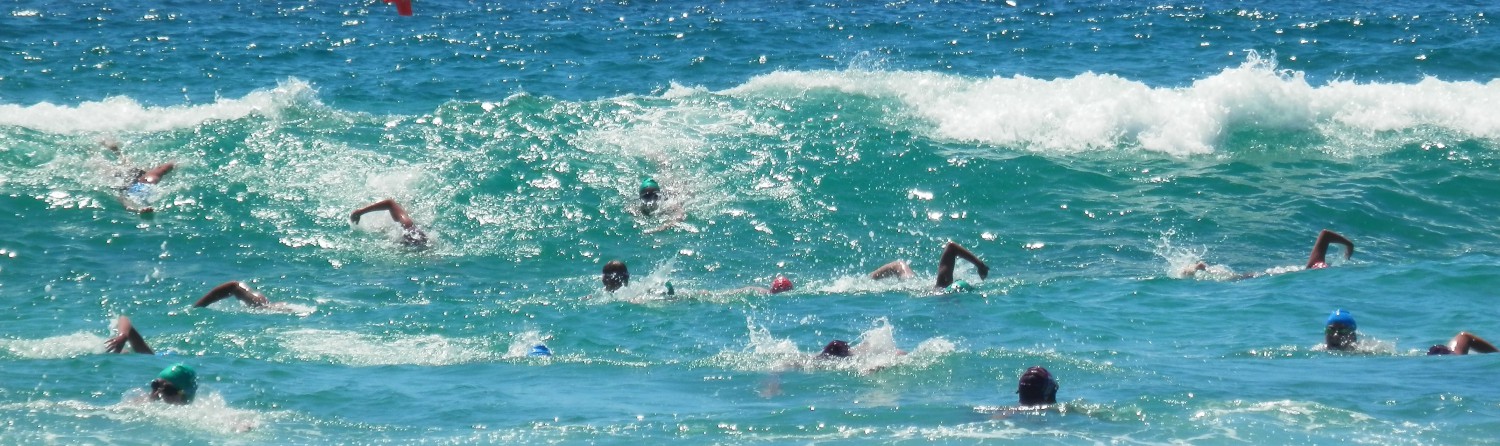
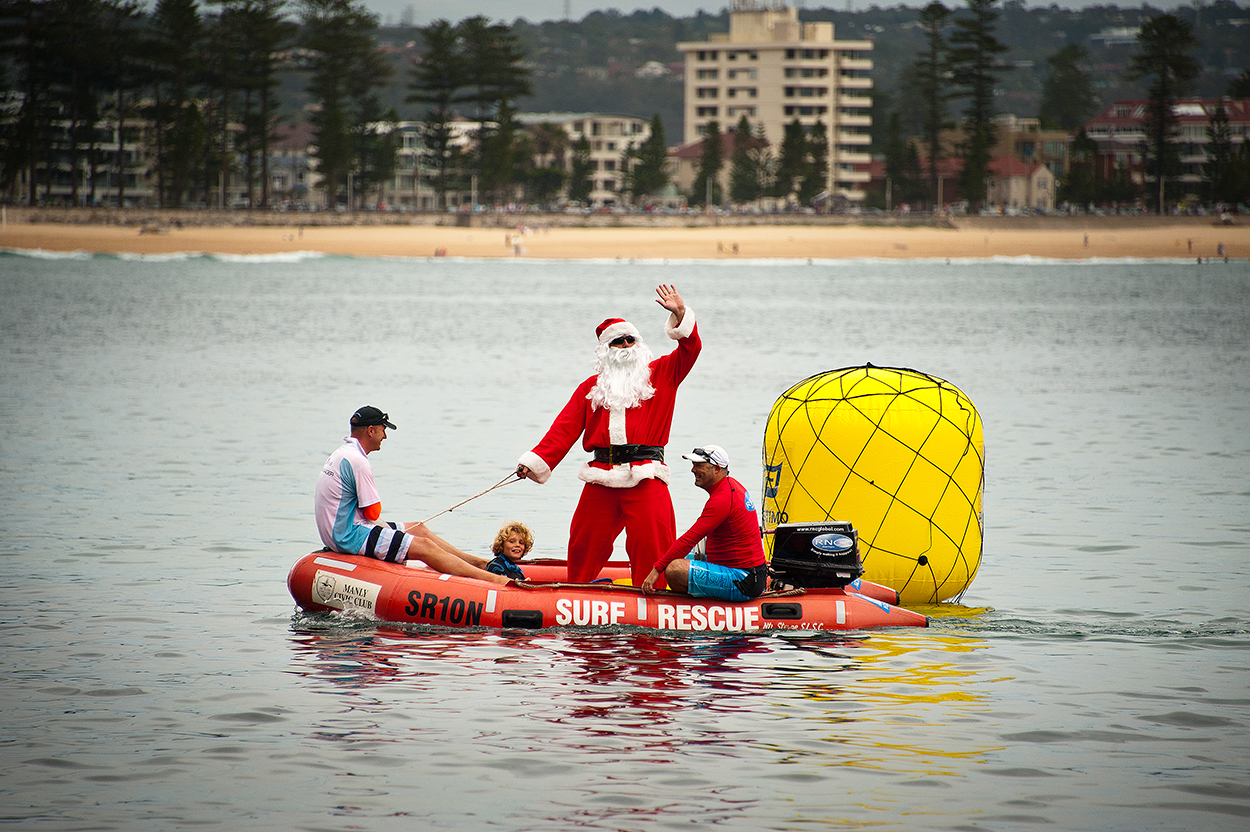
The one km course was similar to the Coles Classic from Shelley Beach to Manly beach, with the advantage of a vastly reduced field. This course is also very protected and goes across the aquatic reserve at Cabbage Tree Bay. There is always plenty of marine life to observe when swimming. There were several members of the squad doing the swim, though not as many as for the eastern suburbs events. We wandered over to the start line at Shelley Beach and waited for the start. The starters were very relaxed, which may have had something to do with the presence of Santa Claus with the water safety crew.
Once again I had entered two races, but this time I wanted to swim a fast time for the one km event. As my wave entered the water I took my usual place on the edge and headed towards the first buoy near Fairy Bower. This time the water was smooth and flat with only a gentle zephyr disturbing the water. This suited me just fine and I powered through the water.
There was only a small shore break as I entered the wave zone after rounding the point. I caught a small wave and stood up and ran fast (well fior me anyway), and crossed the finish line. My time of just over fifteen minutes was a very good time for one km, and I was placed in the top one hundred. A very pleasing result.
The only problem was that I may have swum a bit too hard and now I had to do the two km race. I was keen to beat Michael again, but he was canny and only entered the longer race. This race started at North Styne and then out to sea for several hundred metres before turning right to cross the reef into Shelley Beach. It then followed the one km course to finish at Manly Beach.
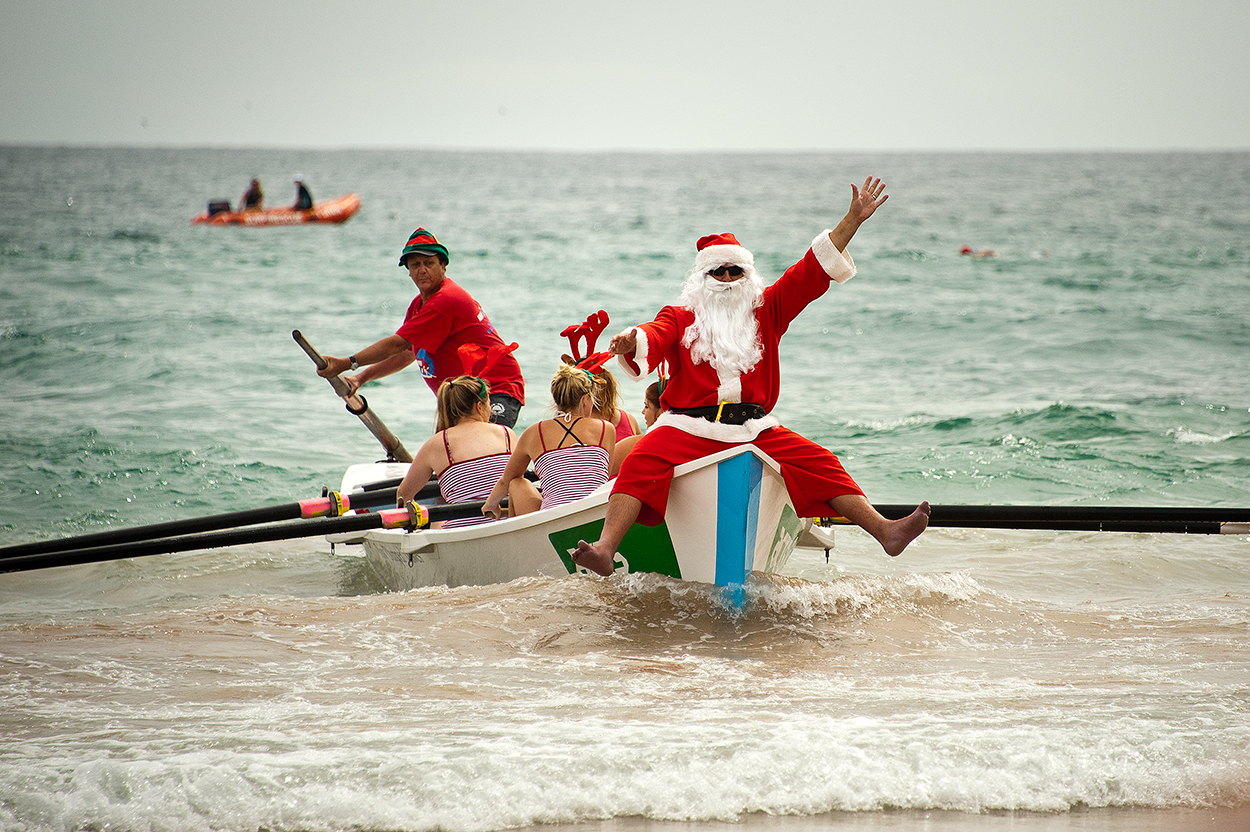
Keep those feet dry Santa
Once again Michael and I were in different waves and my wave entered first. By the time we started the sea breeze had just started up so the water was not as smooth as it had been for the earlier swim. Luckily there was only a small break to get through and I had managed to locate a small rip to help me get out.
The swim was enjoyable, especially crossing the reef near Shelley Beach. It is always fun swimming in places that are different in controlled conditions. I had planned to swim fairly steadily until I got to Shelley beach to save energy for the second half of the race. This time I followed the plan, and when we turned just off Shelley Beach I increased my speed for the final push home. After all I wanted to try to beat Michael.
The rest of the swim was uneventful. I crossed the line in a little over thirty-eight minutes to finish around half way in the field of just under 400 hundred. Unfortunately for me Michael beat me by a minute. Clearly his decision to miss the one km race worked for him.
It is great to swim at these swims on the northern beaches as the competitors are usually more relaxed than the normal eastern suburbs crowd.

Start at Bondi
I had wanted to swim in the famous Bondi to Bronte swim but had never done so. The swim starts at Bondi Beach and swims south to Bronte a distance of around two and a half km. It is held in early December each year and attracts a large number of competitors. This year there were 1,885 finishers to the race.
My fellow squad members told me that if I could handle the Wedding Cake Island swim at Coogee, then this swim would be no problem. So I entered the race. I was quietly confident as I knew my training had made me stronger, and I had swum most of the course before with my squad.
I arrived at Bondi beach to be greeted by a warm sunny morning and a gentle offshore breeze. The weather forecast was for a strong southerly change with rain and increasing swells expected around lunchtime. As my wave was scheduled to be the last one off the beach at 10.30 am I was hoping the change would be late. But as I did a warm up with the squad we felt the change hit. It instantly got colder, and the ocean started to change from mirror smooth to choppy.
The organisers had advised that as the water temperature was above 18 degrees (18.1 officially), competitors who chose to wear a wet suit would not be eligible for prizes. By this time I had put my gear on the truck to be transported to Bronte, so I could not retrieve my bag. I had no choice but to swim with only my speedos on.
By the time my wave time approached, the wind had increased in strength and the chop increased. I thought about walking to Bronte instead of doing the swim, but I thought it would be warmer in the water. The last two waves were combined due to the deteriorating conditions.
My wave started and I reluctantly went in the water. I told myself to take it easy as I had the strength to make the distance. I was the last swimmer through the marking buoys just off the beach, but I soon started to pass other swimmers. The chop was heavy and we were swimming straight into an increasing wind. This was going to be a test of my swimming stamina.
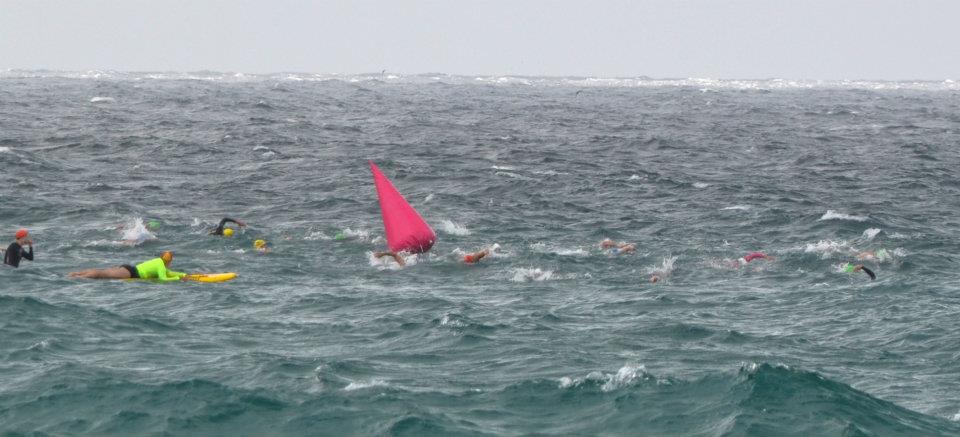
Part of the course off Bronte
Each stroke was a struggle as the waves and wind pushed me around. This was so much more difficult than swimming in flat open water. I remembered that I had to shorten my stroke to reduce the buffeting from the chop, but it still felt like I was swimming in a washing machine. Every stroke was a struggle to try to keep the body in a straight line and to keep moving forward. At times I could feel the chop pushing my legs away from me. I even found lifting my head high enough to get a breath quite difficult at times.
I approached a buoy off Tamarama Beach and it seemed to take forever to swim around it due to the impact of the swell and wind. I had caught a number of swimmers in earlier waves and I thought that they were struggling big time. I learnt after the race that a large number of people had to be rescued due to the combination of the adverse conditions and cold water. Luckily I was carrying a bit of extra weight so I was insulated to some extent.
I finally turned at the last buoy off Bronte, so there was not far to go. I was worried about the rip at that beach and the impact of the increasing swell on the shore break. Fortunately as I approached the wave zone there was a lull and I even managed to catch a small wave into the beach. I had made it. I saw other competitors wrapped in thermal blankets, and I felt sorry for them and the water safety people. Just after I finished the clouds opened and it started to rain.
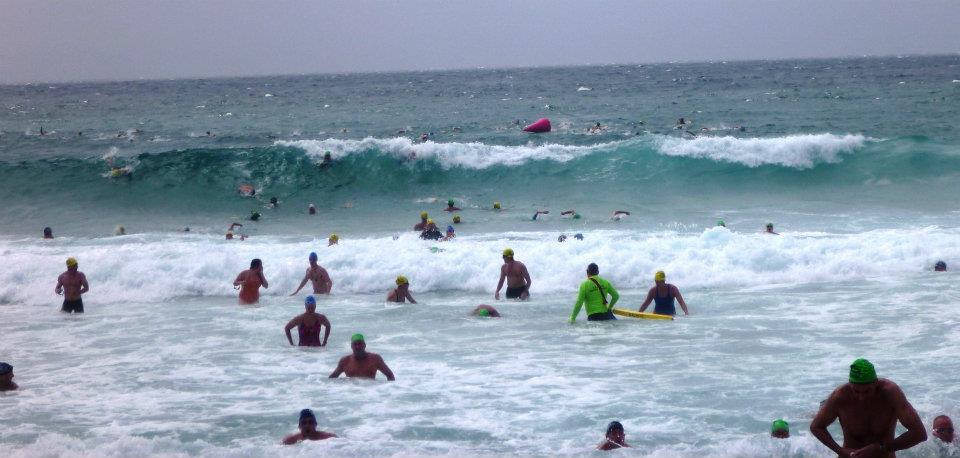
The finish at Bronte
I was quite happy that I had completed the swim. Other people I spoke to who had done the swim many times said this was one the toughest swims they had ever done. Usually they advised the swim was beautiful and a joy. Today the joy was in finishing.
My time was slow just over one hour. My nemesis Michael had swum eleven minutes faster, but he made me feel better by saying that I had the very worst of the conditions. My memories of a top ten finish in my age group at Coogee the previous weekend were distant, as I finished 64th out of 112 in my age group and 1150th overall. Yes I had struggled in the conditions, but I had made it. My stroke despite the conditions was strong the whole way. I now had to work on making adjustments to the conditions, and to try to increase my speed whatever the course presented. I was faster in flat water, but I knew that I would have to expect choppy conditions more often.

Wedding Cake Island
After several months of training and the Cockatoo Island swim, I decided to enter some races on the following weekend. I had decided to try something new and swim both the short and long races where they were offered. My first hit out was to be at Toowoon Bay on the Central Coast on the Saturday. I also entered the Wedding Cake Island swims at Coogee scheduled for the following day. This would be the first time I had proposed to do swims on consecutive days, with four swims in two days. I just hoped I would not over stretch myself.
The Toowoon Bay swim was in a beautiful stretch of beach near The Entrance about one and a half hours drive north of Sydney. There was a two km and a one km swim on the program so I entered both. The weather on the morning of the race was awful with lots of rain and a strong onshore wind from the north-east. I made the drive to the beach to be greeted by a cancelled swim due to high seas and strong rips all through the course. This was very disappointing. My wife and I drove down to Bateau Bay beach and walked on the sand by ourselves, a novelty that we do not often get to enjoy in Sydney. The organisers of the swim sent me a free t-shirt as I had entered the swim early.
During the drive back to Sydney the rained stopped and soon the winds dropped and the sun came out. I felt sorry for the organisers of the Toowoon Bay swim, but it looked good for the swim at Coogee on the Sunday.
The forecast for the Sunday was for warm sunny weather and light winds, and only a one metre swell. Sounded perfect. As I jumped on the Coogee bus I felt confident of swimming well. I had done plenty of sessions in the surf at Bondi, and my confidence in the surf had increased. I also knew that Coogee rarely got a big swell due to the presence of Wedding Cake Island offshore.
I had never swum this course before, but had read a lot about it. The swim in November 2010 was accompanied by cold water resulting in numerous swimmers having to be rescued due to hypothermia. Fortunately the water temperature this year was warmer. However, as I did a warm up for the one km swim the water felt cool.
My plan for the one km swim was to use it as a warm up for the longer swim. I was in the same wave as Michael again, and I planned to sit on his feet this time and then swim away from him towards the end. As we entered the water I kept my eye on Michael and tried to put my plan into action. This time it worked. I stayed on his feet gaining the benefit of drafting for the first three-quarters of the swim. I had noticed that there was not too many swimmers with my cap colour ahead of me, so I decided to put a big effort in for the last portion of the race. I knew that Michael breathed on his right, so I swum on his left and soon left him behind. I swam hard all the way to the beach and ran up to the finish line. My time was slow for a one km swim, and it felt like a long way. I surprised myself by getting my first top ten finish in Sydney in my age group, but more importantly had beat Michael by nineteen seconds.
The only problems was that now I had to do the Wedding Cake Island swim, a distance of 2.4 km. I hoped that I had not put too much effort into the one km race, but I did feel a bit tired. After a change of timing chip, a drink and something to eat, I was soon lining up for the longer swim. This swim involved swimming out from the beach and around Wedding Cake Island and return to the beach. There was nearly a thousand swimmers in this race, and I was in a different wave to Michael this time. So if I was to beat him I would have to rely on a different tactic.
I noticed the elite wave was swimming too far left when they started. Was this a current, or was their navigation faulty? Soon enough we realised that the buoy they were swimming for had been moved after the start of the race. As my wave started I made sure I was on the side of the wave in order to keep away from the rest of the swimmers. I still did not want to be caught up in the melee at the start, and this tactic worked well.
About halfway out to the island I realised that I had swum too fast in the previous race, so I adjusted my pace accordingly. Soon after we started hitting the ocean swell and chop and this always made me swim slower. I knew that I had to shorten my stroke, but found this difficult as it did not feel normal. I enjoyed the view of the ocean floor at the back of the island and the feel of all the jelly blubbers. I had noticed that a number of swimmers were swimming close to the wave zone at the back of the island and I did not want to get too close. I swam wider to swim in smoother water, even though it was a bit further.
My navigation was working well, and I had little trouble sighting the buoys. I found that I would lick a landmark behind the buoy and would use that to aim for. I was looking ahead every ten strokes or so just to make sure I was not off course. I also discovered that I was swimming faster when I breathed to the left, even though I could not keep it up for long.
Before I knew it I was at the beach and I ran up the sand to the cheers of my fellow squad members. My time was just over fifty minutes, and this placed me haf way in the field. But more importantly Michael had beat me by a mere nine seconds.
So I had swum two races on the one day for the first time. I had learnt that the shorter swim was a good warm up for the longer race, as long as I took it easy.
Now for the next challenge.
After my trip to New York, I headed back to the squad to keep up the training. I was still in the second fastest lane, but I was slowly moving up the swimming order within the lane. I was finding that I was making more of the time repeats in the lane. That told me I was getting stronger and faster in the water. I had managed to swim over fifty km in training each of two months, so I was keen to see how much I had improved in the open water.
I entered the Cockatoo Island swim in Sydney Harbour and realised this was the third consecutive year time I had entered this swim. I even convinced a few fellow squad members to join me, even though they had concerns about the possibility of sharks. I found this odd as they had no issues in swimming in the ocean with the “protection” of a shark net.

The start
Once again the weather was good for the swim, which was one of the first for the new 2012 swimming season. This time I was in the first wave, which was no reflection of my ability but a mere reflection of being over forty and male. I had a plan for this swim to swim on Michael’s feet around the island and then swim past him on the way back. We started in the water together but I lost him as we swum past the moored boats on the swim across to the island. Oh well that is the thing about plans in open water, they rarely materialise.
The course was very familiar to me, and I had learnt at squad training to breathe on both my right and left sides. So this time I could breathe left and look at the island as I swam around it. Once again I had settled onto my normal pace and kept it up around the island. Despite this I had the faster swimmers in some of the later waves swimming past me, and I had not managed to sight Michael.
Once I had swum around the island, I turned for home and noticed that most other swimmers had swum away from the turning buoy, increasing the distance they had to swim. I swam by myself for a while until I caught a number of other swimmers on the reach back to the finish line. I remembered the sighting drills from training and navigated quite well, and increased my pace. I made it to the finish line and was glad of the hands that reached down to assist me in getting out of the water. I was also happy that this swim was using timing chips this year, as it makes the times more accurate.
As I walked back to the Dawn Fraser Pool to get my complimentary bbq and fruit I kept an eye out for Michael. I had a choice to make: whether to eat the bacon and sausage sandwich, or the sliced mango (the fruit won and it was divine). When the results were posted I realised that he had finished nearly forty seconds ahead of me. My time though was two minutes faster than the previous year, and I had finished in the top half of the field. This was evidence that my swimming was improving. I was pleased with my efforts.
After the swim my wife and I enjoyed a walk down Darling St in Balmain and lunch at the Riverview Hotel which was owned at one time by Dawn Fraser. My thoughts turned to the swim for next week.
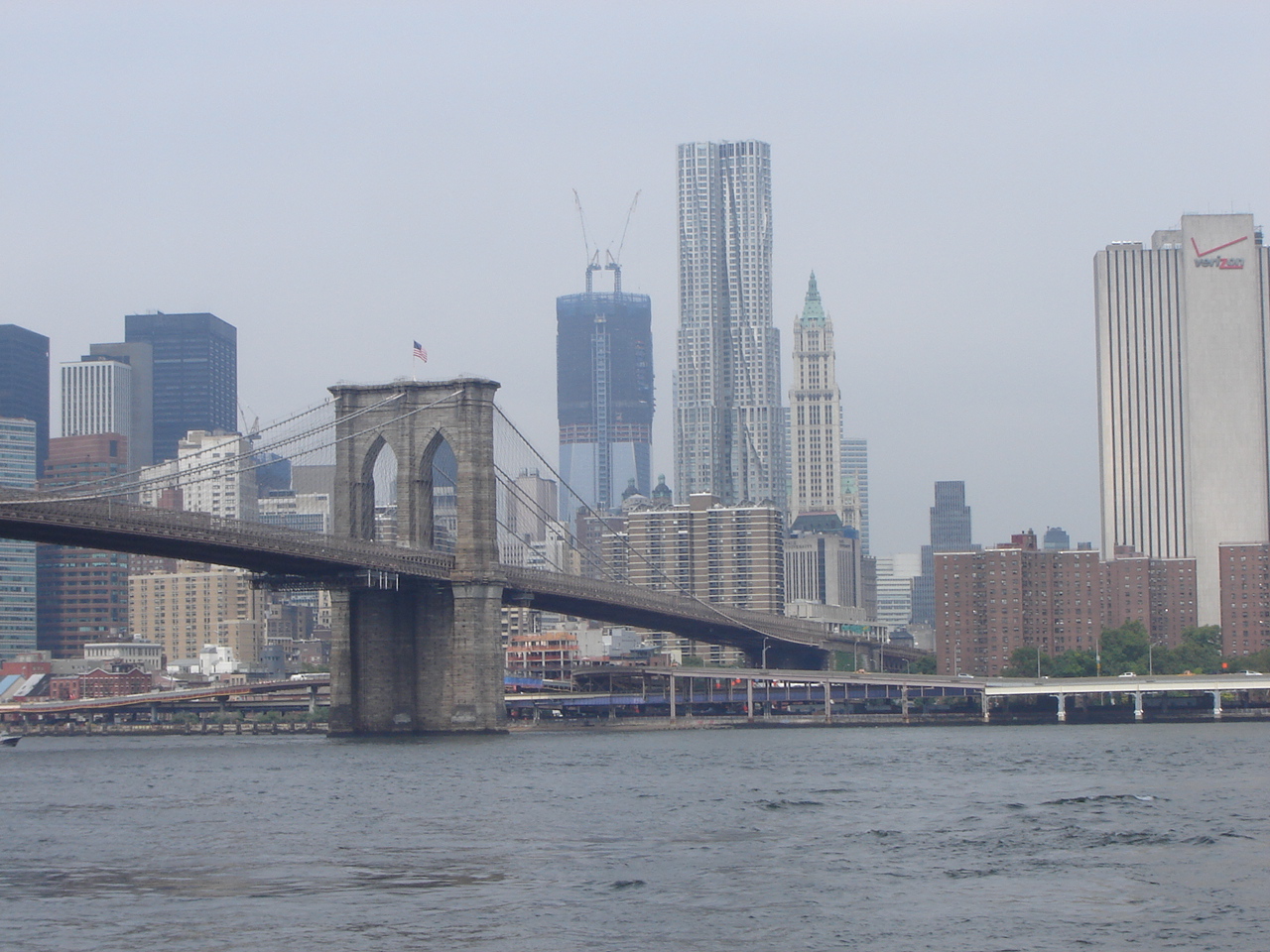
Brooklyn Bridge
We had been planning a trip to New York City for a few months, and my research had revealed a swim under the Brooklyn Bridge was to be held while I was there. I was intrigued by the course and the reputation of the waters around New York of being quite dirty. I had read of the exploits of Shelley Taylor Smith swimming the marathon round Manhattan swim and coming across bodies in the water. After some research on the nycswim.org website and despite the references to flotsam and jetsam in the water I decided to enter the event. After all how often can a resident of Sydney get to swim in New York? The cost was high compared to the swims in Australia, but hey it was all about the experience.
The actual swim was from Fulton Landing near the Manhattan Bridge, downriver to the Brooklyn Bridge and then across to the Manhattan side of the East River, a distance of about one km. I went to the swim course the day before so that I was comfortable with the location, and how to get there on the subway.

Another view of the course with both bridges
I had made contact with a fellow swimmer from Australia, Alan, who had swum the Governor’s Island swim previously. We agreed to meet near the start line.
When I arrived for registration I was asked if I was wearing a wet suit for the swim. When I replied no, they said oh you are an Aussie and you are used to the cold water then. When I enquired as to the water temperature I was told it was around 75 degrees (about 24 C). That was warm and I wondered why anyone would wear a wet suit.
The organisers wrote my entry number on my arm and told me I was in wave five of the seeded nine waves. I was not used to seeding as the events at home had waves based on age. So that was different. I was also told to be sure to line up in numerical order when the wave was called. I thought that was strange too, as the numbers we had at home were only for identification if the chip fell off, or for a medical emergency. Alan and I chatted about how warm it was, and how much the current was moving in the river. He was in wave one, so he hit the water first.
My swim plan was to swim as hard as I could to start with in order to swim away from the others in my wave. With any luck I could catch the wave in front of me who left a few minutes previously. I also made note of the briefing where we were told to keep the deck of the Brooklyn Bridge above us once we arrived at the part of the course.

The course under the bridge
As we waited for our wave to enter the water I looked around at my fellow competitors and thought that they looked different to the surf swimmers I was used to in Sydney; they had less of a sun tan and less sun damage to the skin. A guy behind me boasted about his long drive from Baltimore to do the swim. I asked him how long that took and he said about three hours. He asked me how long it took me to get there I said twenty-two hours on a plane. He was amazed. I also noticed a swimmer wearing Bondi Icebergs swimmers.
We entered the water at a small beach to wait for our water start. Fortunately I was towards the front of my wave so I moved to the front to put my race plan in action. Soon enough we had started and I was swimming away from most of the others in my wave. By the time I arrived at the first turning buoy I had caught swimmers from the previous wave. I felt fast and strong knowing that all that training was starting to pay off.
I turned right at the buoy under the bridge and swam past those in the previous wave quite easily. I was enjoying the swim in the warm brackish water even though it was murky and it was difficult to see past your fingers. Swimming across the East River was relaxing, and I was even catching swimmers from wave three. I was starting to think that this was great and that perhaps I would be doing a good time.
But then the current hit me as I was about two-thirds of the way across the river. It was pushing me upstream, and I had to go downstream to get to the next buoy. I then realised that I had not swum under the deck and was off course. Looking around I realised that most other swimmers were more off course than me. I put in big strokes and remembered to try to swim across the current and not into it. After a few minutes of seemingly making no progress I got out of the current and made it to the stanchion. I looked up for the finish line and noticed that swimmers in front of me were swimming past the finish line and were having to swim back. I took note of that and aimed for the small beach just up-stream from the finish line to allow the current to push me directly to the finish. Before long I was standing up and was out of the water.

Coming out of the East River
I was thrilled and amazed that I had just finished the race. The Brooklyn Bridge is an icon, and I had just swum under it. I was floating on cloud nine and gave a big smile for the volunteers and my support crew. I was timed at just over twenty minutes for the one km whihc was a lot slower than my pool time for the same distance, but was a good indicator of the strength of the current. The time placed me in the top forty-five of the 320 swimmers, and I had finished eighth in my age group. That was my first ever top ten finish in my age group so I was very happy with that. It was also my best overall placing in a swim event. I thought I may have to swim here more often with those sorts of results. I had even managed to beat Alan, even though he was a far more experienced swimmer than me. It turned out that wave one had more of a current to deal with the whole way. Oh well the luck of the draw.
I was very impressed with the efficiency of the race organisers, and even more impressed with the gift bag containing amongst other things a t-shirt. I was used to buying them at home, so it was good to get one for free.
As I sat down to a nice cold beer at the presentation I thought that now I have competed in races on two continents. I had now swum in the Atlantic Ocean (well a tidal river that feeds into a harbour that goes into the Atlantic) to add to my races in the Pacific Ocean, and my swims in the Indian Ocean at Cable Beach in Broome in Western Australia.
Now I could enjoy the rest of my holiday knowing that I had achieved another goal.

The start line at Mona Vale
The swim at Mona Vale is held towards the end of June each year. It comprises a short swim of 1.2 km from Bongin Bongin Bay around the point to Mona Vale beach. Swimmers are given the option of swimming with or without wet suit, with encouragement given to the latter. Even though the swim is held in winter, the water is usually quite warm, and on the day it was still twenty degrees. The day was lovely with plenty of sun and no wind, so that meant no wetsuit for me.
After a pleasant drive to the Northern Beaches of Sydney, I arrived at the beach. Registration was completed and so I sat in the sun soaking up the rays. The surf was flat and virtually non-existent which pleased me no end. Before long it was the turn of my wave to enter the water. I had noticed the path the earlier waves had taken, so I kept to the left hand side of the course. The water was clear and warm and a joy to swim in.

The course around the point
My race plan was to enjoy the swim, swim easy until about the half way point and then to try and swim harder until the finish line. As the swim developed my plan was put into place. As I rounded the point I started swimming harder and soon swam past other swimmers. I felt very strong the whole way. There was no problem navigating as there was no chop and the backdrop of the club made the finishing point easy to spot.
I crossed the finish line and was given a piece of paper with my time on it: no fancy timing chips for this swim. I was pleased with my time of just over twenty-two minutes, coming in the top seventy-five competitors. I was very happy with that placing as it was my first time in the top one hundred swimmers. So perhaps the efforts I had put into my squad training over the last few months were starting to bear fruit.
But the best part of the swim was the hot soup and bread rolls for all competitors at the finish. It was so good I went back for more. Fantastic to be part of a lovely swim with warm friendly volunteers from the local surf club. I would definitely do this swim again.
The 2011 season was over (note the season runs from 1 June till 30 May). In that period I had swum in six swims for a total distance of 13.4 km. Each event was at least two km, and I never did two races on the one day. The boffins at oceanswims.com do a tally of everyone in Australia who enters these swims. For that season there were 43,461 swimmers who competed in a race. I was ranked 1,398 by distance covered. (For NSW I was ranked 509th out of 17,154). When I looked at the tallies I was amazed that anyone could swim more than fifty km in the season.
There are a couple of handicap systems used. The one operated by oceanswims uses a formula which adjusts for the age of the swimmer. It is run on seven or so swims a season with a prize offered to the top ranked swimmer who swims at least three of those designated events. The prize is a trip to Turkey, or the South Pacific to swim in an event. For that competition I had swum three races and ended up with around 185 points (max 300) and a ranking of 246 out of 357.
The other handicap system compares your time with that of the fastest swimmer as a ratio of the slowest swimmer to the fastest. For the season I accumulated just under 400 points with the average of my best three swims of 76 (out of 100). This placed me 212nd out of 1,143 overall, and 28th in my age group.
So all these stats are ok, and they are something to build on for future seasons.
I had made a big change to my training regime and joined a squad towards the end of the season. I knew that this was a long-term commitment and did not expect to see results overnight. However, my efforts for the last two swims of the season showed me that I was on the right track with an improved performance in each swim. I was getting fitter and stronger in the water, so I would expect to see more improvement over a longer period of time. I had learnt to navigate better in the water, gained slightly more confidence in the surf, and made some friends. My favourite swim for the season was the Cockatoo Island swim, with the Bondi swim a close second.
My plans for the next season included a swim in New York City in July, and goals to improve in the Coles Classic and even do some of the famous journey swims around Sydney.
Who knows what the report at the end of the 2012 season will look like?
This swim was scheduled for Easter Monday, but was postponed due to adverse conditions, with large swells making the swim unsafe. It was finally held towards the end of May. Now you would think that having a swim in the last week of autumn would mean cold water. Well in Sydney you would be quite wrong as the water temperature stays above twenty degrees until June each year. Remember water takes longer to cool than the land. Likewise it takes longer to warm up at the start of summer than the land. That is why the best time for ocean swimming is from March to May each year due to the warm water, the less intense sun, the absence of blue bottles and the generally calmer winds.
By the time this swim had come around I had stepped up my training regime. I was now doing three morning sessions a week in the pool and also most weeks a session in the surf at North Bondi. I was swimming in excess of fifty km a month now, and I was also gaining confidence in the surf. Our sessions in the surf concentrated on getting in and out through the wave zone, navigating in the open water, and the starts. All of these skills were useful to pick up to a beginner like me. I was full of admiration for a couple of gents in their 60s who were still swimming very fast and could body surf extremely well. They had clearly been in the surf all of their lives.
I was still not confident enough to enter both races for this event, so once again only entered the longer event over 2.1 km. The course was a start in the centre of Bondi beach, out to a can off Bondi Icebergs, then across the bay to North Bondi, and back to the finish line in the centre of the beach. At the warm up for the squad we could see where the rip was , and where the sandbank was. Growing up on the beach I had been told to keep away from rips as they could take you out past the break. However, for an ocean swimmer there is an advantage in using the rip to get out past the wave zone for two reasons. Firstly you got there quicker, and secondly the rip reduced the size of the waves. Conversely when you were swimming back to the beach you should aim for a sand bank and not the rip.
Luckily there was not much swell on this day which I was comfortable with. At the start though there was a choice to make: should you enter the water in front of the start line and swim diagonally to the first can; or run down the beach and use the rip to get out. I decided on the latter option, even though my running was very ordinary.
I soon made it out the back, rounded the first can and headed to North Bondi. The water was warm and clear and it was so much fun swimming on a glorious sunny day.
I made it back to the beach without too much drama and feeling quite strong. I had noticed that my training had resulted in me being able to swim stronger for longer and that old tired feeling had disappeared.
It was good to share the experience with other squad members, and I felt a part of a community of swimmers. They had provided support and guidance to me. My time of just over thirty-four minutes placed me just outside the top half of the field of 500 or so swimmers.
I felt glad that I had managed to swim at Bondi when it was only a few months previously that I lacked the confidence in my skills to be able to compete.

Now that I had joined a squad, I quickly increased my training distances. I was now doing around thirty km in the pool per month which was about double what I had been doing previously. In addition to the increased distance, I was also getting fitter with faster laps and repetitions with the squad. I was also enjoying pushing myself in the pool and trying to understand the instructions from the coach.
I had swum the Sydney Harbour Classic in March 2010, so I was keen to do it again to see how I had improved. The distance of two km was quite manageable and the location in Farm Cove near the Opera House was superb. And the only waves and chop on the swim would come from the ferries going to and from Manly further out in the harbour.
Another advantage of doing this swim was that it was a fund-raiser for the Black Dog Institute.
I arrived at the course on another sunny morning and eagerly waited for the start of my event. I was feeling confident of beating my time from last year, but I knew that this was subject to many variables such as tides, wind and different buoy placement.
Once again the wave started and I took note of my coach’s instructions to let the other swimmers go out hard on the basis that I would catch them towards the end. You cannot win the race by the first buoy but you can lose it was one of his sayings. So I let the others start hard and fairly soon I was swimming in clear water. I soon caught up to some other swimmers and enjoyed swimming in their wake, until I noticed they were not heading for the first can. Reluctantly I decided to veer away from them and aim for the can, and sure enough I managed to beat them to it.
Once again the glorious views of the Harbour Bridge, Opera House and the city skyline made it hard to concentrate on the swim. Soon enough I was tuning the last buoy for home and tried to up the pace. But I soon realised that my training had not been for long enough and I could not keep up the pace for long. I climbed out at the end feeling much better than my previous few swims which was a good sign.
My time of just under twenty-eight minutes was ninety seconds quicker than the previous year. I was very happy with that until I realised that my overall placing had dropped from the top one-third of the field to the top forty-five per cent. Umm that was disappointing.
Oh well I would have to do more swim training now in an attempt to improve further.
 GregInTheWater